

Independent reference adaptation · Editorial Policy
Teen Patti is part luck, part skill. You cannot control the cards, but you can control how much you risk, when you fold, and how you read the table — and over many hands those decisions separate steady players from chasers. Here are ten tips that genuinely help, written honestly: none of them guarantee a win, and anyone who promises that is selling something.
India's favourite card games on your phone — claim your welcome bonus, play cash tables and tournaments, and withdraw to UPI.
Download Master APK1. Set a bankroll before you sit down
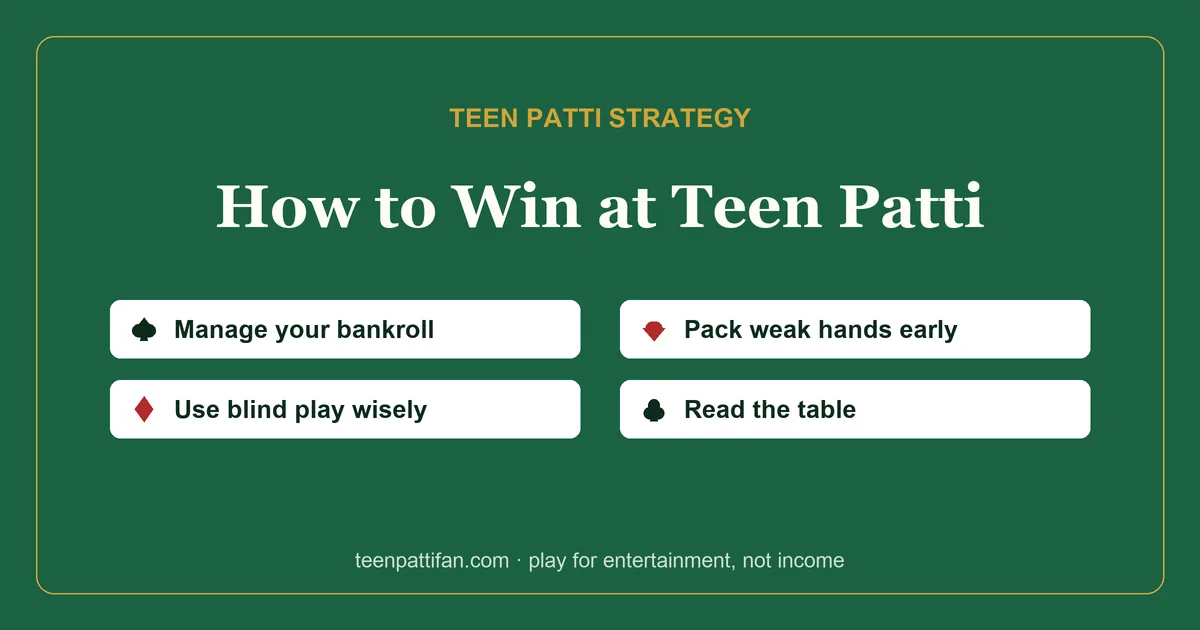
Decide the maximum you are willing to lose before the first deal, and stop when you reach it — win or lose. This single habit protects you more than any card trick. Never chase losses by raising stakes to "win it back."
2. Folding is a winning move
Packing ends your participation in the current hand under the table’s rules. Evaluate that option before paying for another turn simply to satisfy curiosity. In a practice round, record the hand category, current action and remaining players so the choice can be reviewed without letting the eventual result rewrite the reasoning.
Packing weak cards is good discipline, not weakness. You do not have to follow every hand to a show. Players who fold marginal hands early lose small and stay in the game; players who call everything bleed chips slowly.
3. Know the hand order cold
The standard category order is Trail, Pure Sequence, Sequence, Color, Pair and High Card. Recognising that ladder removes one source of comparison errors before any action is chosen. Practise equal-category comparisons too: a pair’s kicker, a sequence’s Ace convention and the table’s exact-tie rule can decide an otherwise similar-looking hand.
You cannot bet well if you hesitate on what beats what. Memorise the order — Trail, Pure Sequence, Sequence, Color, Pair, High Card — so it is automatic. Our Teen Patti sequence list covers it with examples.
4. Use blind play for cheap pressure
Blind status means choosing an action before looking at the cards. The permitted stake can differ from seen play, but paying less on one turn does not establish a favourable outcome. In practice, track status and legal stake together, then consider the option to look or pack before another action.
A blind player usually pays a smaller stake, which lets you apply pressure without committing much. Used occasionally it disguises your hand and unsettles seen players. Used constantly, it just makes your decisions careless.
5. When seen, slow down and think
After looking at the cards, identify the hand category and its relevant ranks before choosing an action. Recheck the current stake, remaining players and applicable table limit. A previous contribution does not require another one; evaluate the next permitted action on its own terms rather than paying merely to continue the story.
Once you have looked, play with intent. A strong hand is worth building a pot around; a weak one is worth folding cheaply. Avoid the trap of paying "just one more" turn out of curiosity.
6. Watch position and player count
Later action can reveal earlier players’ choices, while a larger field creates more possible opposing hands. Those facts affect the information available, rather than revealing any particular opponent’s cards. Use a practice log to distinguish an observed action from an inference, and avoid assigning precise winning chances without a defined model.
Acting later gives you more information about how others are betting. Early on, with many players still in, marginal hands are worth less — someone is more likely to hold something strong. Tighten up when the table is full.
7. Read the table, not just your cards
A table action supplies limited evidence about a decision made under that table’s rules. Note the action, timing and surrounding context before inferring a pattern. Repeated observations can guide a practice discussion, but a fast raise or an early pack does not identify the physical cards in an opponent’s hand.
Observation is the most underrated skill. Note who raises fast, who packs early, who bluffs often. Patterns repeat. The information in how people bet is frequently worth more than the cards in your hand.
8. Bluff with a story, not at random
A bluff is an action intended to influence another player’s interpretation of the hand. Its effect depends on the permitted actions, previous sequence and opponents’ decisions. Use non-redeemable practice points to discuss the logic, and separate a coherent explanation from any claim that an opponent must respond in a particular way.
Bluffing works when your betting tells a believable story. Random aggression gets called and costs you chips. Pick your moments — ideally against cautious players, in smaller pots, when your earlier play supports the bluff.
9. Compare pot size to hand strength
The current pot and the next legal contribution describe different parts of a decision. Identify both, then examine the hand category, possible opposing categories and the table’s remaining action rules. A large pot alone is not a reason to continue, and an undeclared opponent model cannot support an exact winning probability.
Before you keep paying in, weigh the growing pot against how good your hand really is. A medium hand in a small pot is fine to continue; the same hand in a bloated, aggressive pot usually is not.
10. Quit while you are calm
A session limit is most useful when chosen before the results arrive. End the session at the planned time rather than extending it after excitement, frustration or a close comparison. Review decisions later with a clear head, and pause play when the urge to continue begins overriding the original limit.
Tilt — playing emotionally after a big loss or win — destroys more bankrolls than bad cards. Set a time limit alongside your money limit, and walk away on schedule.
Good Teen Patti is mostly discipline: fold often, bet with purpose, read opponents, and protect your bankroll. Skill improves your odds — it never removes the luck.
Myths that lose players money
A streak, lucky seat or repeated tap pattern does not change the stated card rules or establish the next dealt hand. Separate observations from claims about causation. Practise the actual ranking and action sequence, then judge an explanation by its assumptions and evidence rather than by a single memorable outcome.
New to the game?
Start with the complete rules — boot, deal, blind vs seen, show and sideshow — then come back to these tips.
Read the Teen Patti rulesFAQ
These answers resolve the short questions that arise while using Teen Patti decision guide. Read each answer with the convention or product record identified in the article. A general game rule, a source-listed amount and an account-specific condition answer different questions, so keep their original context together.
Is Teen Patti a game of skill or luck?
What is the best strategy for beginners?
Can you guarantee a win in Teen Patti?
India Games Guide Editorial Desk
The editorial desk maintains the source adaptation, rule explanations, app particulars and descriptive links. Read the editorial method and correction policy.
Related Guides
The related guides extend the decisions introduced in Teen Patti decision guide: learn the underlying game rule, inspect a particular product record or check an account-safety question. Select the descriptive topic that matches your next task. App information and promotional figures stay attached to their own source records.