
On this page
This contents list links directly to the main questions in How to play Teen Patti. Choose the rule, account condition or worked example that matches your question, then follow the related topic links for the next step. All sections remain available in the same page without opening a separate language edition.
What Is Teen Patti?
Teen Patti is a three-card comparison game using a standard deck and an announced turn structure. Players contribute the boot, act blind or seen and resolve the hand through the permitted show process or the final remaining participant. Learn the category ladder and exact table conventions before considering an action.
Teen Patti, which simply means "three cards" in Hindi, is one of India's most loved card games. It is a three-card comparison game played around a shared pot, and it is especially popular during Diwali, festivals and family gatherings. The goal is simple: make — or convincingly represent — a stronger three-card hand than everyone else, and win the chips in the middle.
A round uses a standard 52-card deck with no jokers, and works well with three to six players. Before any cards are dealt, every player puts in an equal opening stake called the boot, which creates the starting pot. From there, the betting and bluffing begin.
Teen Patti Hand Rankings (High to Low)
Teen Patti first compares the hand category, then the relevant card ranks within an equal category. Trail leads the standard ladder, followed by Pure Sequence, Sequence, Color, Pair and High Card. The worked examples use the stated Ace convention; suits do not automatically decide equal-rank hands.
Everything in Teen Patti depends on these six rankings. Learn them first, because every call, raise, pack and sideshow decision flows from knowing what beats what. Anything higher on this ladder beats everything below it.
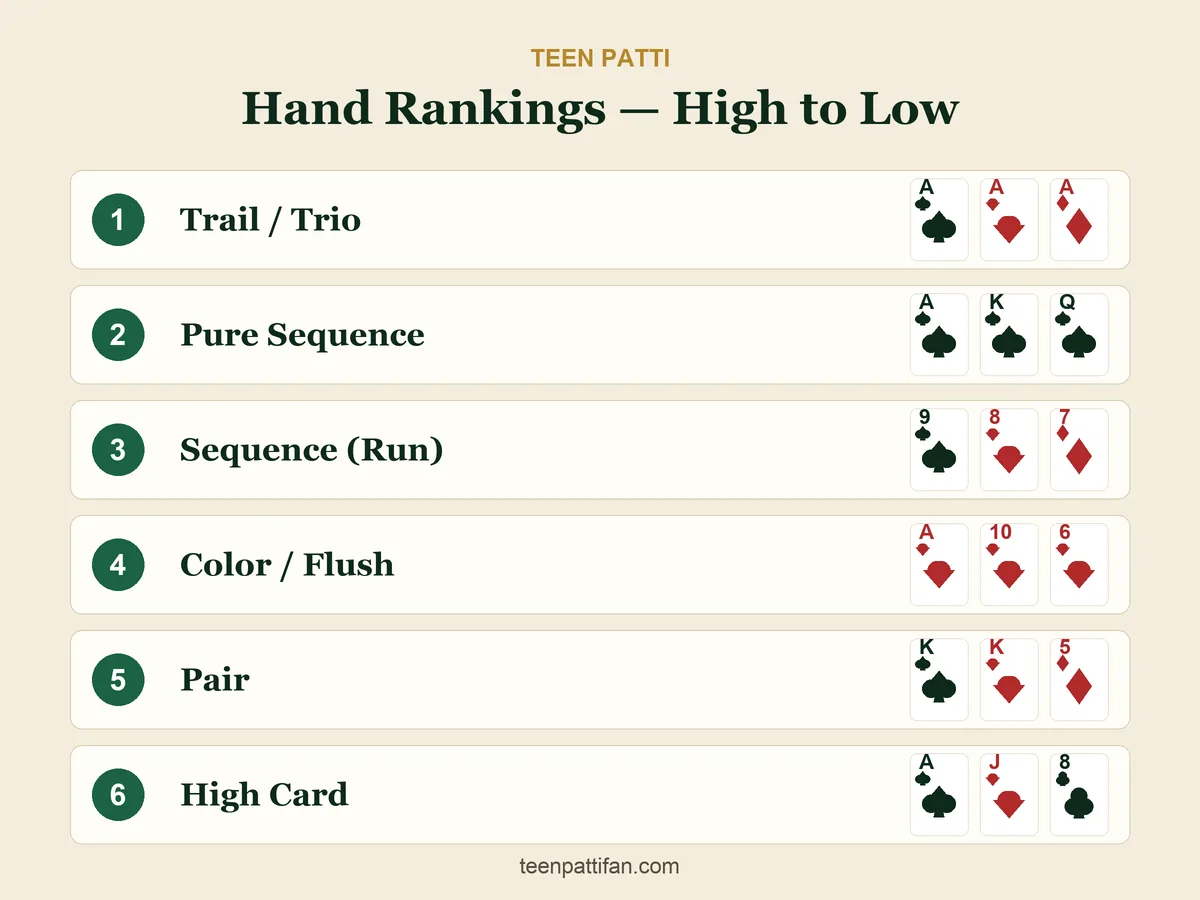
Trail beats everything, then sequences (pure before mixed), then color, then pair, then high card. A common surprise for beginners: a pure sequence beats a color, even though both can look "strong".
Compare two standard Teen Patti hands
Use six different physical cards from one 52-card deck. This tool evaluates standard no-joker Teen Patti; variant construction and low-hand rules are explained in their own guides.
Hand A
Hand B
How a Teen Patti Round Works
A round moves from the boot and deal to a sequence of legal actions by the remaining players. Track whose turn it is, blind or seen status and the current stake before each action. A show follows its own eligibility and payment rules; packing ends one player’s participation in that hand.
Once you know the rankings, the round itself is straightforward. Action moves clockwise, and on your turn you decide how much to risk — or whether to fold.
- Boot: Every player places the boot to create the starting pot.
- Deal: The dealer gives three face-down cards to each player.
- Blind or seen: Each player chooses to keep playing without looking (blind) or to look first and play seen.
- Betting: In turn, players may chaal (match the stake), raise, request a sideshow when allowed, or pack (fold).
- Show: When only two active players remain, a show compares the hands.
- Winner: The higher-ranked hand wins the pot — or the last player left after everyone else packs.
Blind vs Seen Play
This is the decision that gives Teen Patti its character. A blind player has not looked at their cards and usually pays a smaller current stake, which keeps pressure on the table cheaply. A seen player has looked and can make calmer, informed decisions — but typically pays a higher stake under common rules.
Show and Sideshow Rules
A show settles the final comparison under the table’s rules, while a sideshow is a separate comparison request available only in defined circumstances. Check the remaining players, blind or seen status and required payment first. A request does not itself establish eligibility or consent; follow the acceptance and refusal rules below.
A show is the final comparison, usually requested when only two active players remain. Both reveal their cards and the higher hand wins. A sideshow (sometimes called a compromise) is different: a seen player can ask the previous active player for a private comparison. If accepted, the two hands are compared privately and the weaker one must pack. If rejected, play simply continues.
Sideshow timing, whether A-2-3 outranks other sequences, and joker variants all change from table to table. Before the first deal, agree on boot size, show rules and which variant you are playing.
Popular Teen Patti Variants
Read the variant name before applying the standard chart. The changes below affect what the table is trying to achieve or how a hand is constructed; agree on the selected version before the deal so everyone compares the same thing.
Each of these has its own full rules and strategy — read them in our complete Teen Patti variants guide.
Beginner Tips That Actually Help
Begin with the hand ladder, then practise identifying the legal action from the current table state. Use non-redeemable points and explain each choice before viewing the result. Record the stake, player count and stated convention, so a surprising outcome does not replace a clear review of the original decision.
- Packing weak cards is good play, not weakness. You do not need to follow every hand to the show.
- High card is not automatically strong — pair, color, sequence and trail all beat it.
- Blind play creates pressure, but using it too often makes your decisions careless.
- Watch the rhythm of the table: who raises fast, who packs early, who bluffs often.
- Compare the pot size with your hand strength before you keep paying in.
- Set a budget before you sit down and stop when you reach it — win or lose.
Want a printable cheat sheet?
Use the hand-ranking chart on this page as a phone-friendly reference, and consult the linked strategy guides for the decisions that follow from it.
The Teen Patti Stars BlogTeen Patti FAQ
These answers resolve the short questions that arise while using How to play Teen Patti. Read each answer with the convention or product record identified in the article. A general game rule, a source-listed amount and an account-specific condition answer different questions, so keep their original context together.
What is the highest hand in Teen Patti?
Which is bigger, a Trail or a Pure Sequence?
Can a blind player keep playing without seeing the cards?
Which sequence is higher, A-K-Q or A-2-3?
Related Guides
The related guides extend the decisions introduced in How to play Teen Patti: learn the underlying game rule, inspect a particular product record or check an account-safety question. Select the descriptive topic that matches your next task. App information and promotional figures stay attached to their own source records.