

Independent reference adaptation · Editorial Policy
If you only memorise one thing about Teen Patti, make it the sequence list. Every decision — whether to chaal, raise, request a sideshow or pack — comes back to one question: does my hand beat theirs? This guide lays out the full ranking order, with examples for each hand and answers to the questions players ask most.
India's favourite card games on your phone — claim your welcome bonus, play cash tables and tournaments, and withdraw to UPI.
Download Master APKTeen Patti Sequence List (High to Low)
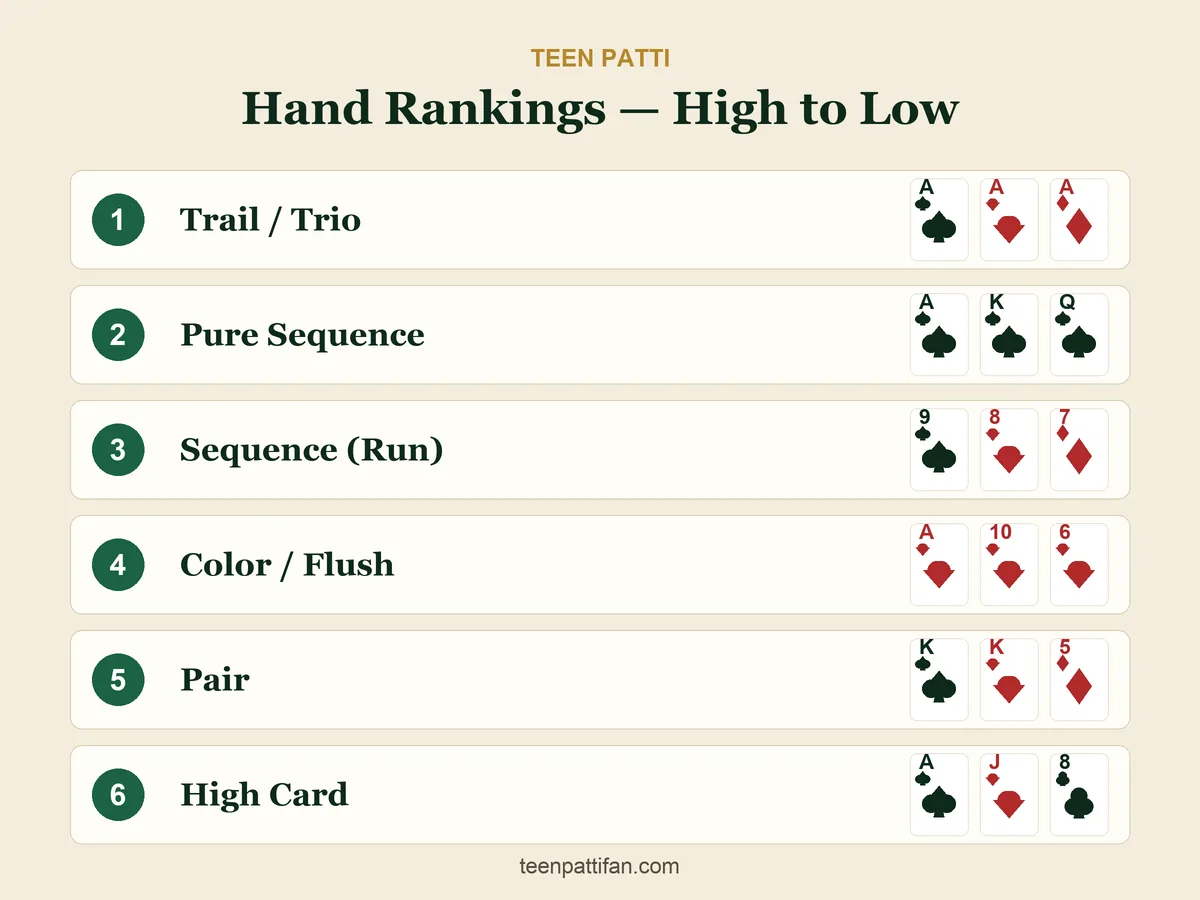
Standard Teen Patti compares categories in this order: Trail, Pure Sequence, Sequence, Color, Pair and High Card. Check the category before comparing ranks within it. The chart and examples below preserve the stated Ace convention; apply a separately announced rule when playing a variant that changes hand construction or comparison.
Here is the standard order used in almost every casual and app-based game. Anything higher on this list beats everything below it.
Strength order and deal frequency answer different questions
The category chart is a comparison rule. The probability guide separately counts all 22,100 no-joker three-card combinations and explains why that count is not a forecast of a particular pot.
The Teen Patti Sequence List in Pictures
Standard Teen Patti compares categories in this order: Trail, Pure Sequence, Sequence, Color, Pair and High Card. Check the category before comparing ranks within it. The chart and examples below preserve the stated Ace convention; apply a separately announced rule when playing a variant that changes hand construction or comparison.
Read the visual from the strongest category downwards, then match it with the written comparison chart. Keeping the illustration and the rule together helps when two hands look similar but belong to different categories.
Each Hand Explained
The category definitions below separate repeated ranks, runs and shared suits before examining tie breakers. Classify all three physical cards first, then compare the relevant ranks within that category. Keep the stated Ace convention visible and use the table’s own exact-tie procedure when two hands have equal rank strength.
Trail (Trio): the strongest hand. Three Aces (A-A-A) is the best possible Trail; three 2s is the weakest. Rare, and almost unbeatable when you hold one.
Pure Sequence: three consecutive cards in the same suit, such as 8-9-10 of hearts. A common surprise for beginners is that a pure sequence beats a color — sequence order matters more than suit alone.
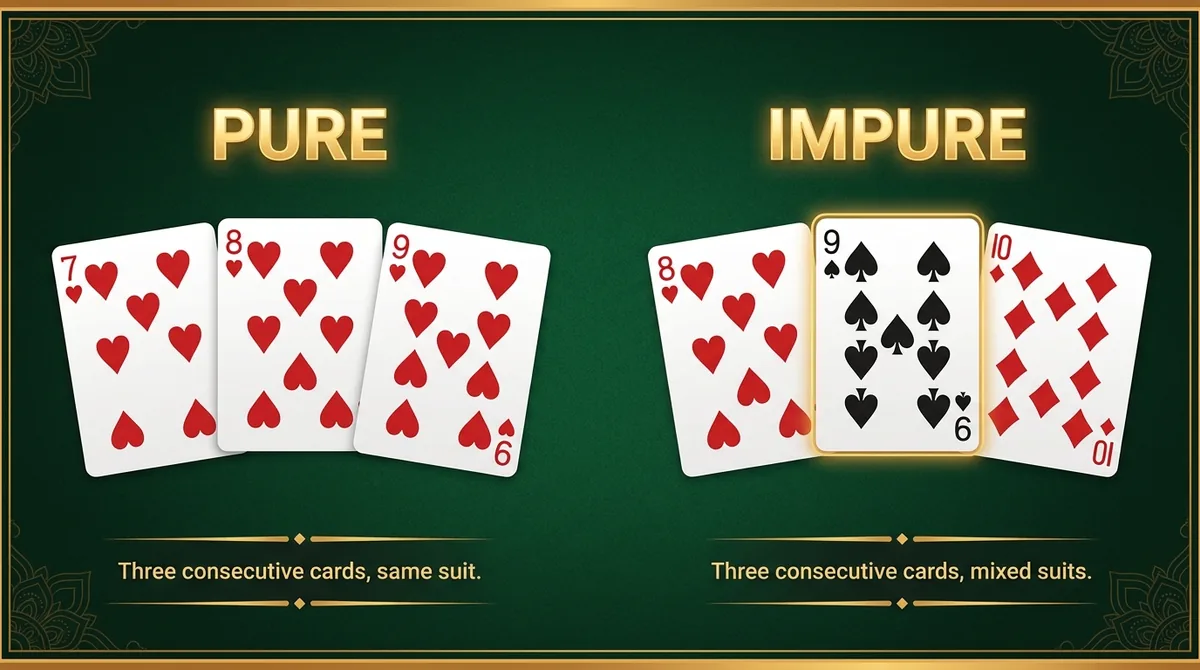
Sequence (Run): three consecutive cards in mixed suits, like 9♠ 8♥ 7♦. Same shape as a pure sequence, but because the suits differ it ranks one step lower.
Color (Flush): three cards of one suit that are not consecutive. When two players both hold a color, compare the highest card, then the next, and so on.
Pair: two cards of the same rank plus a third card. Higher pairs beat lower pairs; if the pairs match, the third "kicker" card decides.
High Card: no combination at all. The single highest card decides, then the next. A-high is the strongest high card.
Many beginners assume a color beats a sequence because "all one suit looks strong." It does not. Pure sequence > plain sequence > color. Lock that order in.
A-K-Q vs A-2-3: Which Sequence Is Higher?
The common convention used in this guide places A-K-Q first and A-2-3 second among sequences. Some tables place A-2-3 at the low end instead. Announce that choice before comparing hands, and apply it equally to pure and mixed-suit sequences; K-A-2 is outside the accepted run list.
The important step is to choose the Ace convention before play and use it consistently. The ordering below states the convention used in this reference, so the comparison has a defined starting point.
- A-K-Q is the highest sequence (pure or plain).
- A-2-3 is usually the second highest — it outranks K-Q-J.
- 2-3-4 is the lowest sequence.
Note that A-K-Q wraps the Ace to the top, while A-2-3 wraps it to the bottom — but K-A-2 is not a valid sequence, because the run cannot "go around the corner." House rules occasionally differ, so confirm before the first deal.
Whether A-2-3 outranks K-Q-J, how sideshows work, and any joker variants change from table to table. A 30-second agreement before the boot saves arguments later.
How Ties Are Broken
An equal-category Teen Patti comparison uses the deciding ranks in order: the repeated rank for Trail or Pair, the run for a sequence, or descending cards for Color and High Card. Compare the kicker when pairs match. Exact equal-rank hands follow the table’s stated tie procedure rather than an assumed suit ranking.
When two players hold the same type of hand, Teen Patti compares card values:
- Two trails: the higher rank wins (A-A-A beats K-K-K).
- Two sequences: compare the top card; A-K-Q beats Q-J-10.
- Two colors: compare highest card, then second, then third.
- Two pairs: higher pair wins; if equal, the kicker decides.
Rummy Sequence Examples (Pure & Impure) — Visual Guide
Because so many players search for "rummy sequence images" alongside the Teen Patti sequence list, it helps to picture exactly what each combination looks like with real cards. A pure sequence is a run of three or more consecutive cards all in the same suit, with no joker used — for example 5♥-6♥-7♥ or 9♠-10♠-J♠.
Because so many players search for "rummy sequence images" alongside the Teen Patti sequence list, it helps to picture exactly what each combination looks like with real cards. A pure sequence is a run of three or more consecutive cards all in the same suit, with no joker used — for example 5♥-6♥-7♥ or 9♠-10♠-J♠. The cards climb in order and never break suit, which is exactly why it is the cleanest, strongest run you can hold.
An impure sequence is the same idea — consecutive cards — but a joker stands in for a missing card. Picture 5♥-6♥-(joker) standing in for 7♥, or 4♣-(joker)-6♣ where the joker plays the 5♣. The run is valid, but because a wild card props it up it counts as impure, and in 13-card rummy it cannot satisfy the compulsory pure-sequence requirement.
Do not confuse either with a set, which is three or four cards of the same rank but different suits, such as 8♠-8♥-8♦. A set runs sideways across suits; a sequence runs forward through ranks. In Teen Patti the same picture applies but a sequence is always exactly three cards: a pure sequence such as 8♠-9♠-10♠ (same suit) outranks a plain run like 9♠-8♥-7♦ (mixed suits). Use the card images above as your quick reference for what every pure and impure run should look like.
Teen Patti Sequence vs Rummy Sequence
A lot of players search for "sequence list" with rummy in mind, not Teen Patti — and the two are close cousins but not identical. Since the same deck and the same "consecutive cards" idea power both games, here is how a sequence works on each side so you do not mix them up.
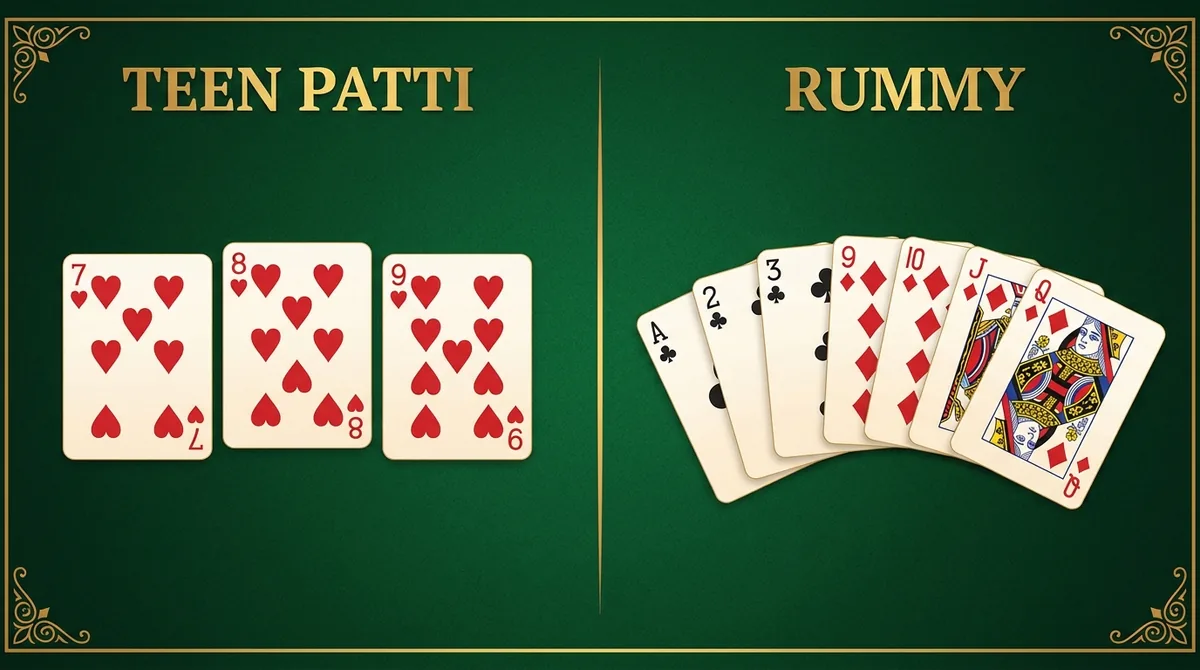
The big practical difference: in Teen Patti a sequence is one possible three-card hand, while in rummy a pure sequence is compulsory — without one, your whole hand is invalid no matter how good the rest looks. If rummy is what you were really after, our pure sequence in rummy guide shows exactly how to build one, and the full 13-card Indian rummy rules cover sets, declaration and scoring.
If you enjoy spotting runs in Teen Patti, rummy rewards the same instinct — just over a longer hand. Many of our readers play both, and the bonus apps in our rummy app list bundle Teen Patti tables too.
Want the full rules, not just the list?
Our main Teen Patti guide covers the betting flow, blind vs seen play, sideshow rules and every popular variant.
Read the Teen Patti guideFAQ
These answers resolve the short questions that arise while using Teen Patti sequence list. Read each answer with the convention or product record identified in the article. A general game rule, a source-listed amount and an account-specific condition answer different questions, so keep their original context together.
What is the correct Teen Patti sequence list from high to low?
Which is the highest sequence in Teen Patti?
Does a pure sequence beat a color in Teen Patti?
Is A-2-3 higher than K-Q-J in Teen Patti?
Is the rummy sequence the same as the Teen Patti sequence?
What is a pure sequence in rummy?
Is 2 3 5 the biggest sequence in Teen Patti?
Does the Teen Patti ranking order change in any variant?
India Games Guide Editorial Desk
The editorial desk maintains the source adaptation, rule explanations, app particulars and descriptive links. Read the editorial method and correction policy.
Related Guides
The related guides extend the decisions introduced in Teen Patti sequence list: learn the underlying game rule, inspect a particular product record or check an account-safety question. Select the descriptive topic that matches your next task. App information and promotional figures stay attached to their own source records.