
On this page
This contents list links directly to the main questions in Indian rummy rules. Choose the rule, account condition or worked example that matches your question, then follow the related topic links for the next step. All sections remain available in the same page without opening a separate language edition.
What Is Indian Rummy?
Indian Rummy is a 13-card matching game and one of the most popular skill-based card games in the country. Unlike Teen Patti, where a round can turn on a single bold bet, Rummy rewards patience and planning — you are constantly drawing and discarding to shape your 13 cards into valid groups before your opponents do.
The game is usually played with two standard decks plus printed jokers, and works best with two to six players. Each player is dealt 13 cards, one card starts the open discard pile, and the rest form the closed draw pile.
The Objective
Your aim is to arrange all 13 cards into valid sequences and sets, then declare before anyone else. To win, your hand must contain at least two sequences, and at least one of them must be a pure sequence (no joker).
Your aim is to arrange all 13 cards into valid sequences and sets, then declare before anyone else. To win, your hand must contain at least two sequences, and at least one of them must be a pure sequence (no joker). This single rule is the backbone of Rummy — without a pure sequence, your declaration is invalid no matter how neat the rest of your hand looks.
Sequences: Pure vs Impure
A pure rummy sequence is a natural same-suit run; an impure sequence completes a permitted run with a joker substitution. A valid declaration still needs its required pure sequence. State the represented card in each impure example, then check all remaining groups and count each of the thirteen physical cards once.
A sequence is three or more consecutive cards of the same suit. There are two kinds, and the difference matters enormously.
- Pure sequence: consecutive same-suit cards with no joker. Example: 5♥ 6♥ 7♥. You must have at least one to declare.
- Impure sequence: a sequence that uses a joker to fill a gap. Example: 5♥ Joker 7♥, where the joker stands in for 6♥.
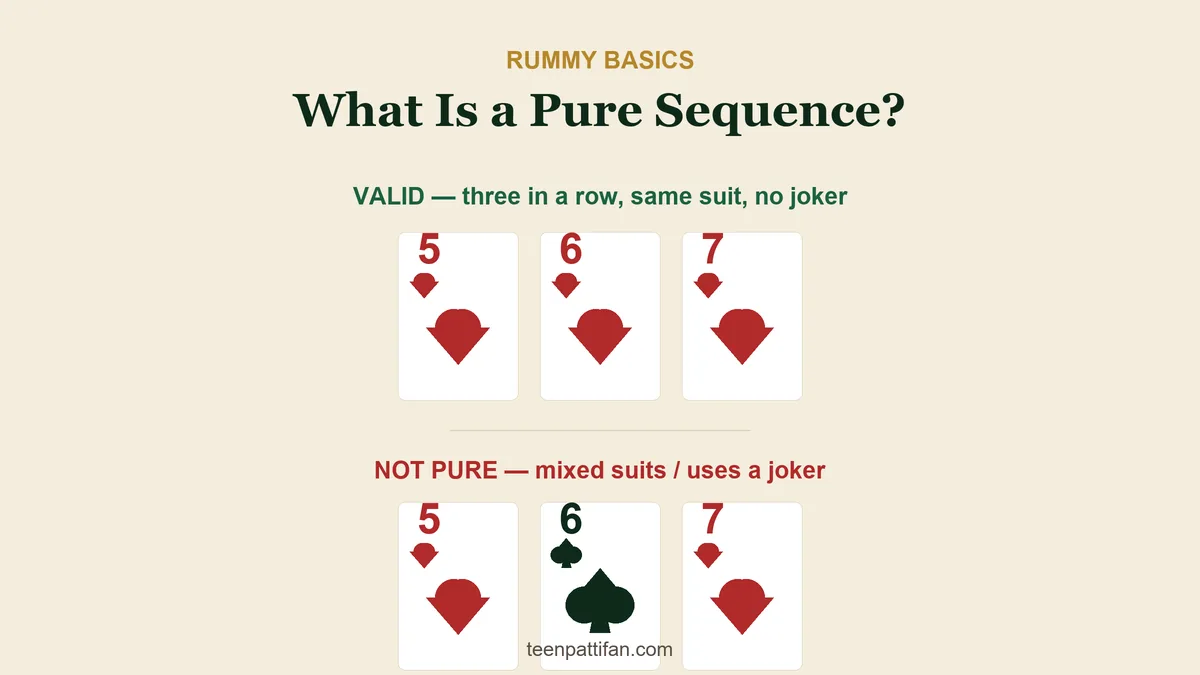
The most common beginner mistake is chasing sets and forgetting the pure sequence requirement. Lock it in early — everything else in your hand depends on it.
Sets
A set is three or four cards of the same rank but different suits. For example, 7♠ 7♥ 7♣ is a valid set. You cannot repeat a suit within a set, but you can use a joker to complete one — for instance, 9♠ 9♦ Joker. Sets are useful, but remember they never count toward your two-sequence requirement.
How Jokers Work
Jokers are wild cards that can substitute for any missing card in an impure sequence or a set. There are two types: the printed joker that comes in the deck, and the wild-card joker, a random card chosen at the start of the round whose same-rank cards in every suit also act as jokers.
Jokers are wild cards that can substitute for any missing card in an impure sequence or a set. There are two types: the printed joker that comes in the deck, and the wild-card joker, a random card chosen at the start of the round whose same-rank cards in every suit also act as jokers. Jokers are powerful, but they can never be used to form your required pure sequence.
Points Calculation
The winner of a Rummy hand scores zero. Everyone else adds up the value of the cards they failed to arrange into valid groups — so the goal when you cannot win is to keep your unmatched cards as small as possible.
Making a Valid Declaration
Before declaring, check the pure sequence, required second sequence and all remaining sets or runs. Account for every physical card once and confirm each joker assignment under the selected rules. A visually tidy arrangement can still fail a requirement, so audit the completed thirteen-card hand rather than only the strongest group.
When your 13 cards are fully arranged, you discard your final card to the finish slot and declare. The game then checks your hand. A valid declaration needs:
- At least two sequences.
- At least one pure sequence (no joker).
- All 13 cards grouped into valid sequences and sets, with no leftover cards.
A wrong declaration usually costs the full 80-point penalty even if your hand was almost perfect. Double-check that your pure sequence is genuinely joker-free before you commit.
Beginner Strategy Tips
Form your pure sequence before anything else — it is the one group you cannot win without. Discard high-value cards (J, Q, K, A) early if they are not helping, to cut your risk if someone else declares. Don't hold too many jokers idle; use them where they unlock the most value.
- Form your pure sequence before anything else — it is the one group you cannot win without.
- Discard high-value cards (J, Q, K, A) early if they are not helping, to cut your risk if someone else declares.
- Don't hold too many jokers idle; use them where they unlock the most value.
- Watch your opponents' discards — they reveal which suits and ranks are safe to throw.
- Know when to drop. A first drop costing 20 points can be smarter than chasing a hopeless hand to a 60+ point loss.
Rummy App Guides
The related guides extend the decisions introduced in Indian rummy rules: learn the underlying game rule, inspect a particular product record or check an account-safety question. Select the descriptive topic that matches your next task. App information and promotional figures stay attached to their own source records.
Beyond the rules, the questions we get asked most are about apps — the ₹51 bonus offers, which new launches to trust, and what "best" even means after the 2025 law change. We keep four honest, regularly updated guides:
Individual write-ups sit alongside those round-ups. Rummy East and Rummy Gold are two of the most-searched names on the list, and between them they show how little an app’s branding tells you about how it actually pays out.
Compare Teen Patti & Rummy
Not sure which game suits you? One is fast and bold, the other is slow and strategic. See how they differ.
Teen Patti guideRummy FAQ
These answers resolve the short questions that arise while using Indian rummy rules. Read each answer with the convention or product record identified in the article. A general game rule, a source-listed amount and an account-specific condition answer different questions, so keep their original context together.
How many cards are used in Indian Rummy?
What is a pure sequence in Rummy?
How are points counted in Rummy?
What happens if you make a wrong declaration in Rummy?
Related Guides
The related guides extend the decisions introduced in Indian rummy rules: learn the underlying game rule, inspect a particular product record or check an account-safety question. Select the descriptive topic that matches your next task. App information and promotional figures stay attached to their own source records.