

Independent reference adaptation · Editorial Policy
In 13-card Indian Rummy, one rule sits above all others: you cannot make a valid declaration without at least one pure sequence. Beginners lose countless games by assembling a tidy-looking hand and forgetting this requirement. Get the pure sequence right and everything else becomes easier.
India's favourite card games on your phone — claim your welcome bonus, play cash tables and tournaments, and withdraw to UPI.
Download Master APKWhat is a pure sequence?
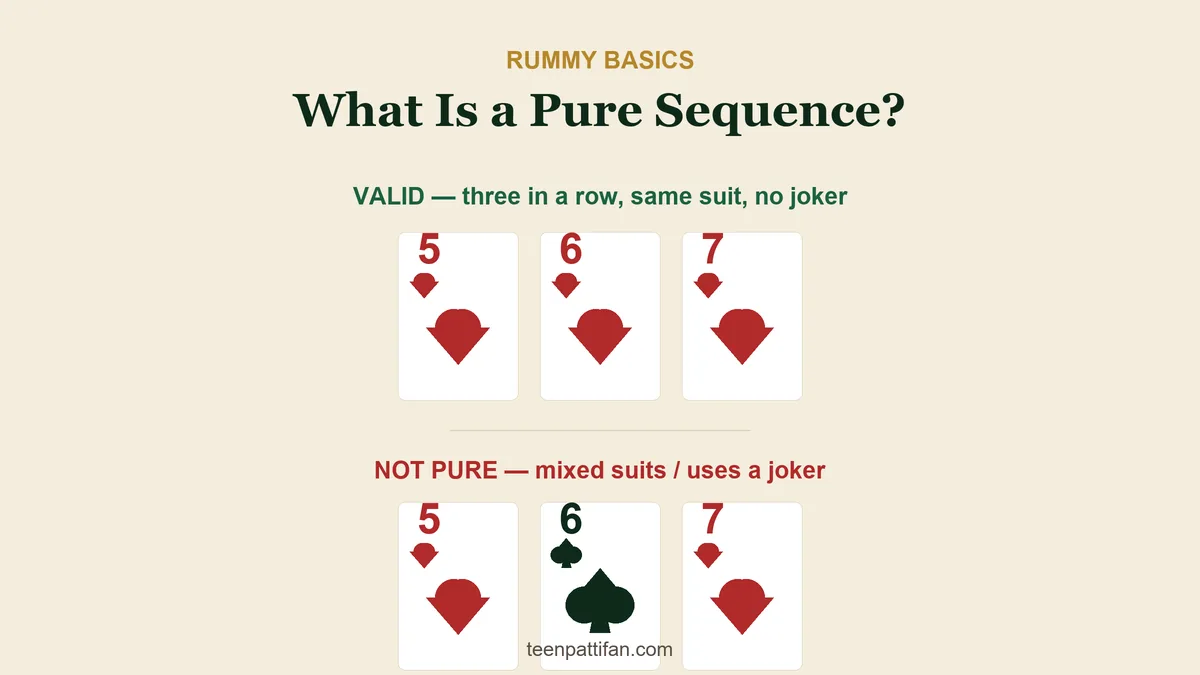
A pure sequence is three or more consecutive cards of the same suit, formed without any joker. For example, 5♥ 6♥ 7♥ is a pure sequence. Four cards in a row of one suit — such as 8♠ 9♠ 10♠ J♠ — is also a valid (and longer) pure sequence.
The defining feature is that no joker is involved. The moment a joker stands in for a missing card, the group becomes an impure sequence instead.
Valid vs invalid examples
A pure rummy sequence uses consecutive natural cards from the same suit under the stated rule. A gap, mixed suit or substituting joker changes that classification. Inspect each physical card in the examples below, then keep the pure-sequence test separate from the additional groups needed for a complete thirteen-card declaration.
Pure sequence = no joker. Impure sequence = a joker fills a gap. You need at least one pure sequence to declare; impure ones only count toward your second sequence and sets.
Why it matters so much
The pure-sequence requirement is a gate in standard Indian Rummy declaration checking. Other well-formed groups do not compensate for its absence. Confirm that natural run first, then inspect the second sequence and remaining cards; the scoring consequence of an invalid declaration follows the selected format’s stated penalty rules.
To win a round of Rummy you arrange all 13 cards into valid sequences and sets and then declare. A valid declaration needs at least two sequences, and at least one of them must be pure. If you declare without a pure sequence, the declaration is invalid — and you typically take the maximum 80-point penalty even if every other group was complete. That is why experienced players treat the pure sequence as job number one.
How to build one fast
Build a pure sequence by identifying same-suit connectors and the specific natural cards that can complete the run. Compare alternative groupings before spending a joker elsewhere. Track visible discards and overlapping candidates carefully, because a flexible shape creates more possible completions without assuring that the required card will arrive.
- Make it your first priority. Before chasing sets or impure runs, lock in a pure sequence.
- Keep connected cards. Holding 6♥ 7♥ gives you two ways to complete (5♥ or 8♥) — far better odds than a gap.
- Don't waste jokers here. Jokers cannot help a pure sequence, so save them for your second sequence and sets.
- Discard high unconnected cards early. Lone Aces, Kings and Queens with no neighbours add risk; release them before they cost points.
- Watch the discard pile. Picking the exact card you need beats drawing blind from the closed deck.
A wrong declaration usually costs the full penalty. Before committing, confirm your pure sequence is genuinely joker-free and that you have a second sequence too.
Want the complete Rummy rules?
Our main Rummy guide covers sequences, sets, jokers, points calculation and exactly what makes a valid declaration.
Read the Rummy guideFAQ
These answers resolve the short questions that arise while using Pure sequence in rummy. Read each answer with the convention or product record identified in the article. A general game rule, a source-listed amount and an account-specific condition answer different questions, so keep their original context together.
What is a pure sequence in Rummy?
Can a pure sequence use a joker?
How many cards make a pure sequence?
Why do I need a pure sequence to declare?
India Games Guide Editorial Desk
The editorial desk maintains the source adaptation, rule explanations, app particulars and descriptive links. Read the editorial method and correction policy.
Related Guides
The related guides extend the decisions introduced in Pure sequence in rummy: learn the underlying game rule, inspect a particular product record or check an account-safety question. Select the descriptive topic that matches your next task. App information and promotional figures stay attached to their own source records.