

Independent reference adaptation · Editorial Policy
If you already know how 13-card Indian rummy works, pool rummy is the same game wrapped in an elimination scoreboard. Instead of a single hand deciding the winner, you play deal after deal, carrying your losing points forward until everyone but one player has crossed the pool limit. It is the format most online tables and family tournaments use, because it stretches one sitting into a proper contest of patience.
India's favourite card games on your phone — claim your welcome bonus, play cash tables and tournaments, and withdraw to UPI.
Download Master APKOn this page
This contents list links directly to the main questions in Pool rummy 61, 101 and 201. Choose the rule, account condition or worked example that matches your question, then follow the related topic links for the next step. All sections remain available in the same page without opening a separate language edition.
What Is Pool Rummy?
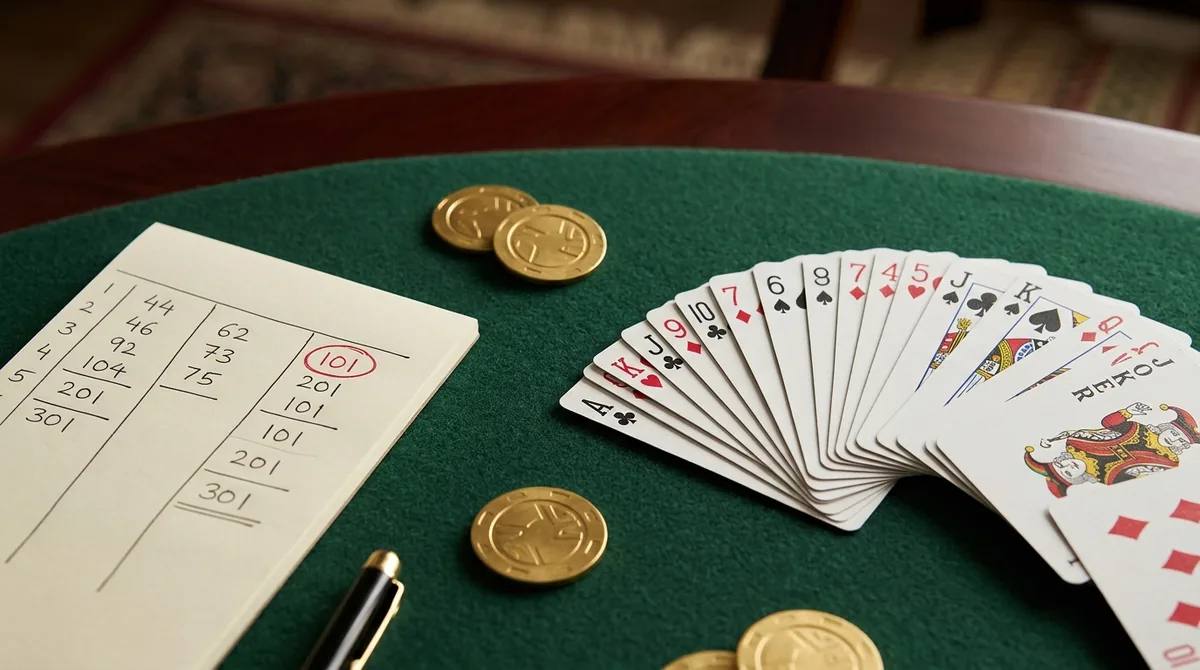
Pool rummy is a points-based, elimination version of 13-card rummy. Every player starts on zero. Each deal is played like normal rummy — build sequences and sets, make a valid declaration — but the loser of each deal does not just lose the hand: they add that deal's points to a running total.
Pool rummy is a points-based, elimination version of 13-card rummy. Every player starts on zero. Each deal is played like normal rummy — build sequences and sets, make a valid declaration — but the loser of each deal does not just lose the hand: they add that deal's points to a running total. The moment your total reaches or crosses the pool limit, you are eliminated. Play continues until only one player remains under the limit, and that player wins the pool.
The name comes from the shared "pool" everyone is playing toward. Unlike deals rummy or points rummy, where a hand or a fixed number of deals settles things quickly, pool rummy is a war of attrition: you win by not losing.
In pool rummy you are not chasing wins — you are dodging elimination. Keep your per-deal points low, let everyone else bust the limit, and the pool is yours.
101, 201 and 61 Pool: What the Numbers Mean
The numbers 101, 201 and 61 identify cumulative Pool Rummy thresholds in the source’s format descriptions. They describe the score limit that affects continued participation, rather than the number of cards dealt. Read the selected threshold with its elimination, drop and re-entry rules before interpreting any accumulated penalty.
The number in the format name is simply the elimination threshold — the points total that knocks you out. Three variants are common:
The higher the limit, the longer the game and the more room for recovery. In 201 pool rummy, a player eliminated early can often re-enter at the highest current score, so a single bad deal need not end your night. In 61 pool, by contrast, two careless hands can bust you — every point matters from the first deal.
How to Play Pool Rummy, Step by Step
Pick the format and seats. Two to six players, two standard decks with jokers (the same setup as ordinary 13-card rummy). Deal 13 cards each. One card opens the discard pile; the rest form the closed deck. A wild-card joker is fixed for the deal.
- Pick the format and seats. Two to six players, two standard decks with jokers (the same setup as ordinary 13-card rummy).
- Deal 13 cards each. One card opens the discard pile; the rest form the closed deck. A wild-card joker is fixed for the deal.
- Play the deal normally. Draw and discard in turn, building at least one pure sequence plus valid sequences and sets toward a declaration.
- Score the deal. The winner scores zero. Every other player counts the points of their un-grouped cards (face cards 10, numbers at face value, valid groups zero).
- Add to the running total. Each loser's deal points are added to their pool score.
- Eliminate and repeat. Anyone whose total reaches the limit is out. Deal again with the survivors until one player is left.
Scoring and Elimination
Pool Rummy carries hand penalties into a cumulative score, with participation governed by the selected threshold and its stated elimination rule. Track the running total after each deal. A valid declaration, drop or incomplete hand can have different scoring treatment, so apply the original condition attached to that result.
Pool rummy uses the standard rummy points table, with one twist: the points carry forward instead of resetting each deal.
Because a single bad deal can add up to 80 points, one collapse in 101 pool can put you on the brink. This is why disciplined, low-point losing matters more than occasional big wins — the same lesson as our how to win rummy guide, amplified across a whole match.
Drops and Re-entry
A drop ends participation in a particular rummy deal under the selected penalty rule, while re-entry concerns joining the pool again under separate eligibility conditions. Check the timing, score effect and permitted stage for each. Those actions should not be treated as interchangeable merely because both involve leaving an active hand.
Dropping — choosing not to play a deal you have been dealt — is the heart of pool strategy. It costs a fixed penalty that is far cheaper than getting caught with a full hand:
In 201 pool, an eliminated player can usually re-enter by taking a score equal to the highest surviving total, buying back into the game. In 101 and 61 pool, elimination is normally final. Knowing whether re-entry exists changes how aggressively you should drop early on.
Pool rummy is one of the most popular formats on app — you'll find 101 and 201 pool tables, plus a welcome bonus and daily rewards, on Teen Patti Lucky. Prefer a deck? It plays just as well with friends at home.
Pool Rummy Strategy: Survive, Don't Sprint
Pool Rummy practice requires attention to cumulative penalty as well as the current hand. Compare the remaining threshold, exposed points and format’s drop conditions before choosing an action. Review how the decision affects continued participation across deals, and avoid equating one exciting declaration with a sound approach to the full pool.
- Treat every deal as damage control. You rarely need to win — you need to lose small. A deal where you go out with 8 points is a good deal.
- Drop early and without ego. A 20-point first drop on a bad hand is the most underused winning move in pool rummy. Hopeless hands cost 60–80 if you play them out.
- Secure the pure sequence first. Without it your whole hand counts at full value if someone declares — the single biggest source of pool blow-ups.
- Watch the scoreboard, not just your cards. If a rival is near the limit, play tighter and let them bust. If you are the one near the edge, drop freely to stay alive.
- Punish the leaders late. When only two or three players remain, pressure the ones closest to elimination rather than taking risks yourself.
Pure sequence early, cheap drops on bad hands, and constant attention to who is closest to the limit. Pool rummy rewards the calmest player at the table, not the boldest.
New to the 13-card game?
Pool rummy assumes you already know sequences, sets, jokers and a valid declaration. Start with the full rules, then come back.
Read the Indian Rummy rulesFAQ
These answers resolve the short questions that arise while using Pool rummy 61, 101 and 201. Read each answer with the convention or product record identified in the article. A general game rule, a source-listed amount and an account-specific condition answer different questions, so keep their original context together.
What is pool rummy?
What is the difference between 101 and 201 pool rummy?
How do you win pool rummy?
What is a drop in pool rummy?
Is pool rummy legal to play in India?
Sources & references
The references identify the legal framework and supporting public material used in this article. Read the primary document for its scope, commencement and definitions, then distinguish those requirements from a product’s own description. A source-listed bonus, payment method or APK record does not create legal permission to use a money game.
- Indian rummy (rules) — the 13-card base game that pool rummy is scored on.
- Rummy — the wider family of draw-and-discard games and their scoring conventions.
- Online game in India — the legal status of real-money rummy after the 2025 Act.
External links open in a new tab and are provided for verification. We are an independent guide and are not affiliated with these sources.
India Games Guide Editorial Desk
The editorial desk maintains the source adaptation, rule explanations, app particulars and descriptive links. Read the editorial method and correction policy.
Related Guides
The related guides extend the decisions introduced in Pool rummy 61, 101 and 201: learn the underlying game rule, inspect a particular product record or check an account-safety question. Select the descriptive topic that matches your next task. App information and promotional figures stay attached to their own source records.