

Independent reference adaptation · Editorial Policy
Indian Rummy — also called 13-card rummy — is the version of rummy most people in India grew up playing. It uses two decks, a few jokers, and one simple goal: arrange all 13 of your cards into valid sequences and sets before anyone else. The rules look small but the discipline behind a clean declaration takes a little practice. This guide walks through all of it, plainly.
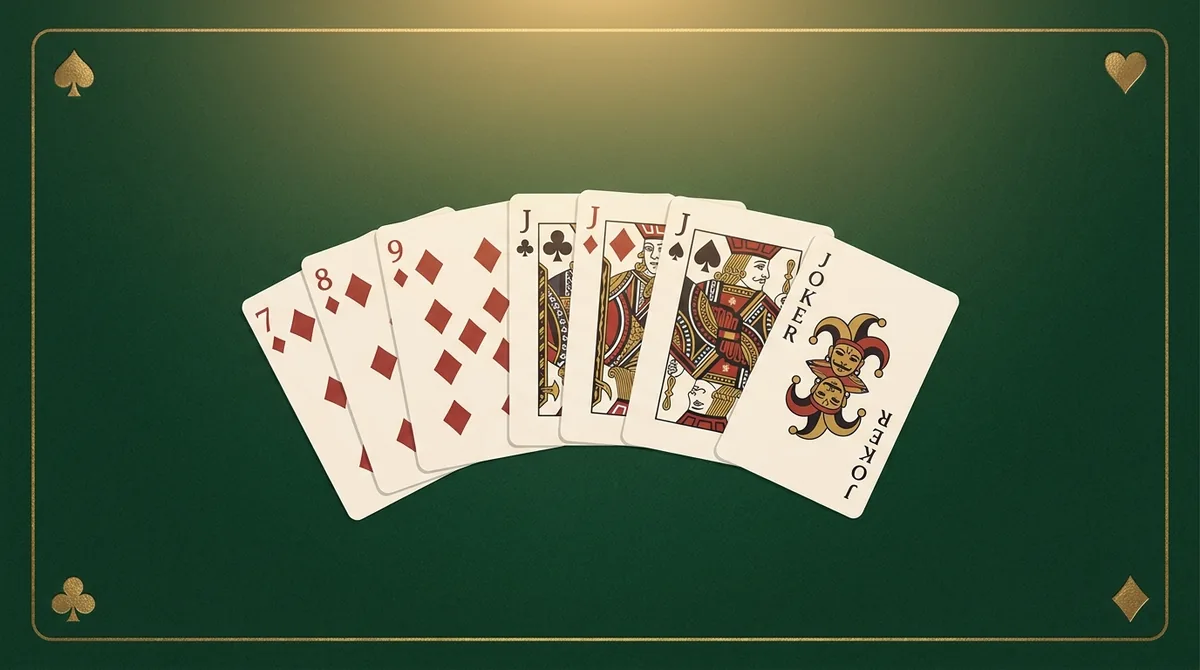
India's favourite card games on your phone — claim your welcome bonus, play cash tables and tournaments, and withdraw to UPI.
Download Master APKWhat is Indian Rummy?
Indian Rummy is a draw-and-discard game for 2–6 players, played with two standard 52-card decks plus printed jokers. Each player receives 13 cards. On your turn you draw one card (from the closed or open pile) and discard one, always keeping 13 in hand. You win by being first to arrange those 13 into valid groups and validly declare.
The goal: a valid declaration
A valid thirteen-card rummy declaration accounts for every card in permitted groups and includes the required sequences. Check the pure sequence first, then the second sequence and remaining sets or runs. Count physical cards once and apply the stated joker convention before treating the arrangement as a completed practice hand.
To declare, your 13 cards must form valid sequences and sets with no leftover cards. Two hard rules decide every game:
- You need at least two sequences.
- At least one of them must be a pure sequence (a run with no joker).
Miss the pure sequence and your declaration is invalid — you are penalised the full 80 points even if the other 10 cards were perfect. That single rule is the heart of the game.
Pure sequence
A pure sequence is three or more consecutive cards of the same suit, without any joker — for example 4♥ 5♥ 6♥. It is the one group you must build first, every hand. We cover it in depth, with valid vs invalid examples, in our pure sequence in rummy guide.
Impure sequence & sets
An impure sequence uses an allowed joker substitution to complete a same-suit run; a set groups the same rank in permitted different suits. Neither removes the requirement for a pure sequence. State which card a joker represents, then check that every group and all thirteen physical cards are counted consistently.
Once the pure sequence is safe, the rest of your hand can use these:
A set cannot repeat a suit (two 9♥ is invalid), and a joker can stand in for a missing card in either an impure sequence or a set.
How jokers work
There are two kinds. The printed joker is the card marked Joker. The wild joker is a random rank chosen at the start of each deal — every card of that rank, in all suits, becomes a joker for the hand. Use jokers to complete impure sequences and sets — never waste them where a natural card would do.
How a turn plays out
Draw one card from the closed deck (unknown) or the open discard pile (known). Arrange — slot it into a forming sequence or set, or hold it. Discard one card face-up to the open pile, keeping 13. When all 13 are grouped, place your 14th drawn card on the finish slot and declare.
- Draw one card from the closed deck (unknown) or the open discard pile (known).
- Arrange — slot it into a forming sequence or set, or hold it.
- Discard one card face-up to the open pile, keeping 13.
- When all 13 are grouped, place your 14th drawn card on the finish slot and declare.
Points & scoring
Rummy scoring assigns penalty values to cards that remain outside qualifying groups under the selected format. A valid declaring hand scores zero in the model described below. Check the pure-sequence condition, card values, any cap and the format’s accumulation rule before comparing a single-hand penalty with an overall session score.
The winner scores zero. Everyone else is scored on the cards still unformed in their hand:
Lower is better — the aim across a game is to keep your point total down.
The three main variants
Points, Pool and Deals change how rummy results are accumulated and when a session ends. Their shared card-grouping rules do not make their score displays interchangeable. Identify the selected format first, then read the source’s per-hand, cumulative-threshold or fixed-deal explanation before interpreting a result or elimination condition.
- Points Rummy — one fast deal; the winner takes points multiplied by a stake value. The most common online format.
- Pool Rummy — 101 or 201 pool; players are eliminated when they cross the pool limit, last one standing wins.
- Deals Rummy — a fixed number of deals; chips change hands each deal and the highest chip count wins.
The core 13-card rules above are identical across all three — only how a game is won or lost changes.
Build your pure sequence first, every single hand. Players who chase a big set before securing a pure run are the ones who get caught with an invalid declaration and the full 80-point penalty.
Ready to play sharper?
Once the rules click, a handful of habits cut your points fast. Our strategy guide has the realistic ones.
How to win at RummyHow to Play Rummy in Hindi, Tamil & Telugu
Indian Rummy plays exactly the same in every language — the 13-card deal, the mandatory pure sequence, jokers and scoring never change. Only the on-screen labels and the words players use differ. Here is a quick term map so you can follow the game in your own language.
Hindi — रम्मी कैसे खेलें
sequence = क्रम / सीक्वेंस, pure sequence = शुद्ध सीक्वेंस, joker = जोकर, meld/set = सेट. खेल हिंदी में कैसे खेलें: 13 कार्ड को कम-से-कम दो क्रम में लगाएं, जिनमें एक शुद्ध सीक्वेंस ज़रूरी है। पूरी गाइड पढ़ें — Indian Rummy: Complete 13-Card Rules।
Tamil — ரம்மி எப்படி விளையாடுவது
sequence = வரிசை, pure sequence = சுத்த வரிசை, joker = ஜோக்கர், set = செட். சுருக்கம்: உங்கள் 13 சீட்டுகளை குறைந்தது இரண்டு வரிசைகளாக அமைக்கவும், அதில் ஒன்று கட்டாயம் சுத்த வரிசையாக இருக்க வேண்டும்.
Telugu — రమ్మీ ఎలా ఆడాలి
sequence = వరుస, pure sequence = స్వచ్ఛమైన వరుస, joker = జోకర్, set = సెట్. సారాంశం: మీ 13 కార్డులను కనీసం రెండు వరుసలుగా అమర్చండి, వాటిలో ఒకటి తప్పనిసరిగా స్వచ్ఛమైన వరుస అయి ఉండాలి.
FAQ
These answers resolve the short questions that arise while using Indian rummy rules. Read each answer with the convention or product record identified in the article. A general game rule, a source-listed amount and an account-specific condition answer different questions, so keep their original context together.
How many cards are dealt in Indian Rummy?
What is a valid declaration?
Can you win without a pure sequence?
Can I play rummy in Hindi, Tamil, or Telugu?
India Games Guide Editorial Desk
The editorial desk maintains the source adaptation, rule explanations, app particulars and descriptive links. Read the editorial method and correction policy.
Related Guides
The related guides extend the decisions introduced in Indian rummy rules: learn the underlying game rule, inspect a particular product record or check an account-safety question. Select the descriptive topic that matches your next task. App information and promotional figures stay attached to their own source records.