

Independent reference adaptation · Editorial Policy
If you typed “13 Patti” expecting another Teen Patti page, here is the thing that trips everyone up: “13 Patti” is not the three-card game. It is the thirteen-card game — what most people simply call Indian Rummy. The name is literal: patti means cards, and you play with thirteen of them. This guide explains what 13 Patti is, the full rules, and the one thing (the pure sequence) that decides every hand.
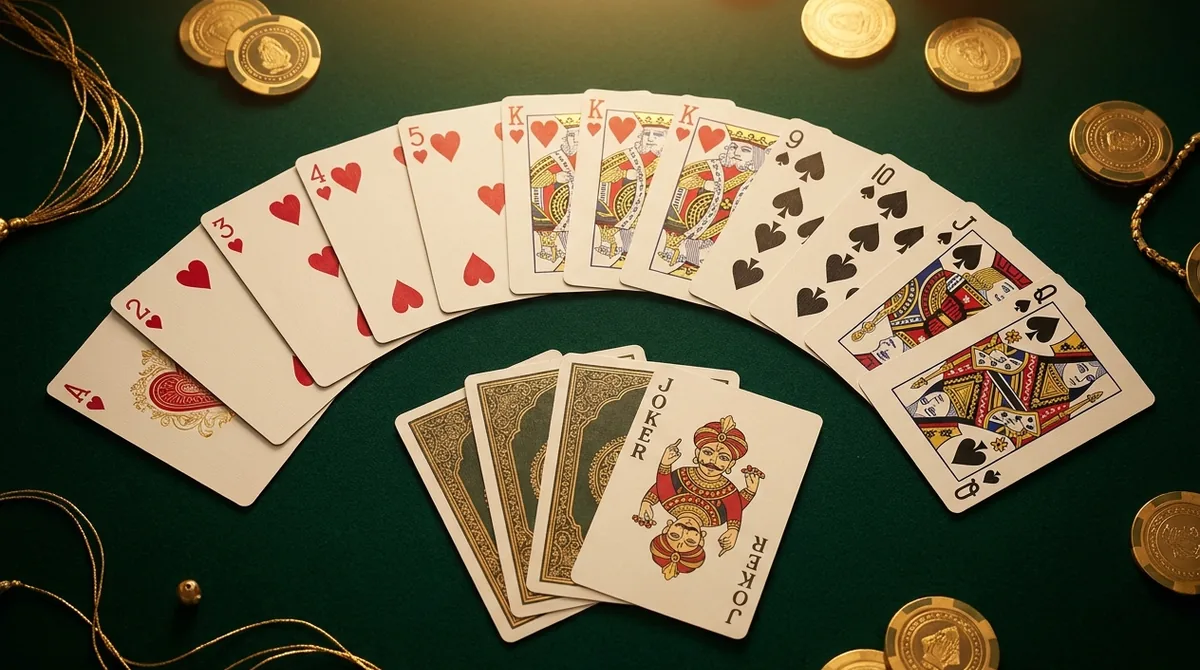
Practice tables and cash rummy on your phone — learn by playing, claim a welcome bonus, and withdraw to UPI. 18+, APK download.
Download Master APKWhat Is 13 Patti?
13 Patti means thirteen-card Indian Rummy: draw, discard and arrange the full hand into valid sequences and sets. At least one sequence must be pure, and the required second sequence must also be present. The name identifies the hand size; it does not describe the three-card comparison game called Teen Patti.
13 Patti is 13-card Indian Rummy. It goes by several names — 13 Cards, 13 Card Rummy, Paplu, or just Indian Rummy — but they all describe the same game. You are dealt 13 cards and your job is to arrange every one of them into valid sequences (runs) and sets (groups of the same rank), then be the first to declare a complete, valid hand.
The single rule that defines the game: you must have at least two sequences, and at least one of them must be a pure sequence (a run with no joker). Get that wrong and your declaration is invalid — even if every other card is perfectly grouped. That one requirement is what separates winners from “wrong show” penalties.
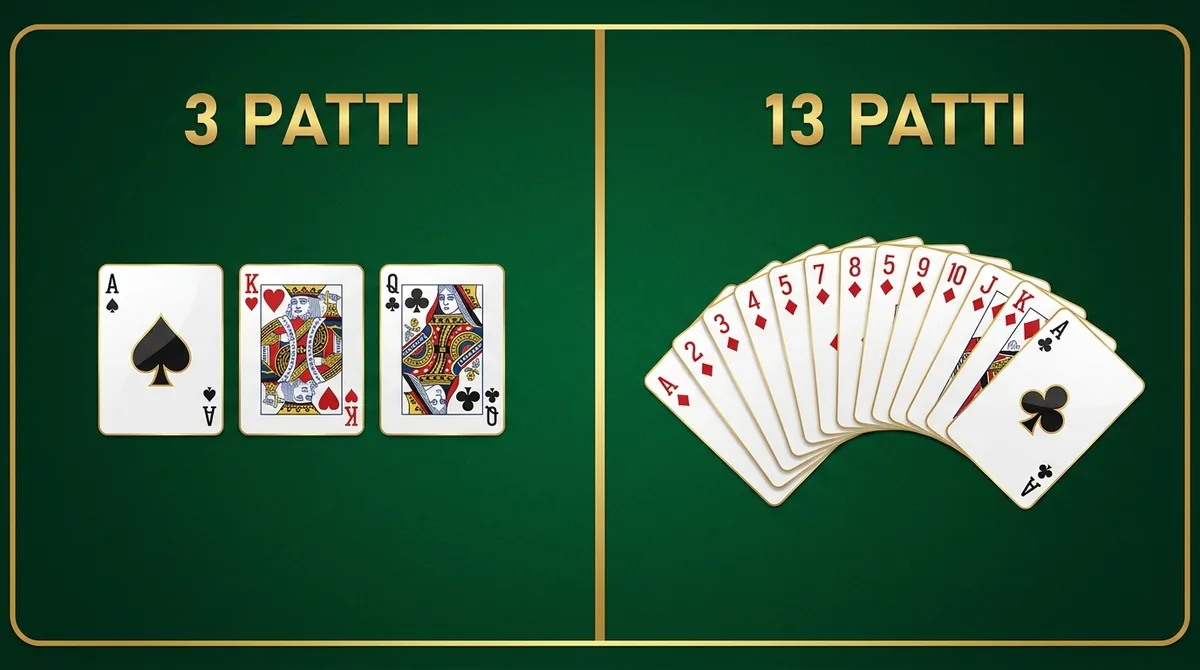
The number is the fastest way to tell the two games apart. 3 Patti / Teen Patti = 3 cards (a betting and bluffing game). 13 Patti = 13 cards (a melding and skill game). Same deck, very different game.
13 Patti: The Quick Rules
On your turn you pick one card (from the closed deck or the open discard pile) and throw one away, slowly shaping your 13 cards into groups. The moment all 13 form valid groups with the pure-sequence rule satisfied, you put your hand down for a “show” and win.
On your turn you pick one card (from the closed deck or the open discard pile) and throw one away, slowly shaping your 13 cards into groups. The moment all 13 form valid groups with the pure-sequence rule satisfied, you put your hand down for a “show” and win.
Sequences and Sets — the Two Building Blocks
A sequence groups consecutive ranks from one suit; a set groups the same rank across different suits. Those two structures account for every card in a valid thirteen-card declaration. Build the required sequences first, then check the remaining groups for duplicate physical cards, missing connectors and any illegal joker substitution.
Every valid 13 Patti hand is built from just two shapes. Get these and you understand the whole game.
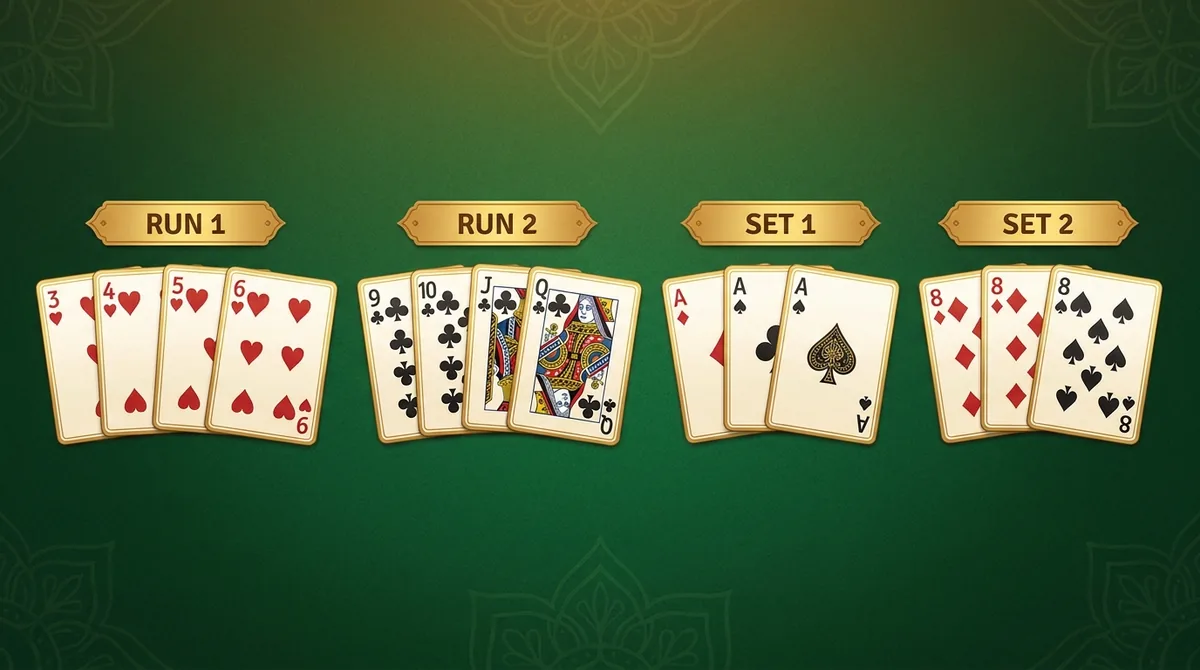
Sequence (run): three or more consecutive cards of the same suit. A pure sequence uses no joker (e.g. 4♥-5♥-6♥); an impure sequence uses a joker to fill a gap (e.g. 4♥-[Joker]-6♥).
Set (group): three or four cards of the same rank but different suits — for example 7♠-7♥-7♣. A joker can complete a set too.
Here is one valid way to arrange a 13-card hand — two sequences (one pure) plus two sets, every card accounted for:
KERJ♠
That is 3 + 3 + 3 + 4 = 13 cards, two sequences (one pure) and two sets — a valid winning 13 Patti hand.
The Pure Sequence: the Rule That Wins or Loses 13 Patti
A pure sequence in standard three-card Teen Patti is three consecutive ranks of the same suit. It sits below Trail and above a mixed-suit Sequence. State the Ace convention before comparing A-K-Q and A-2-3, and keep this three-card category separate from the mandatory pure sequence in Indian Rummy.
Everything in 13 Patti hangs on one card group. A pure sequence is three or more consecutive cards of the same suit with no joker — like 5♥-6♥-7♥ above. You need at least one, full stop. Declare without it and you get a wrong show penalty of up to 80 points, no matter how tidy the rest of your hand looks.
So the smart order of play is: build your pure sequence first, then a second sequence, then mop up the rest into sets using your jokers. We break this down further in our dedicated pure sequence in rummy guide, and the complete ruleset lives in 13-card Indian Rummy rules.
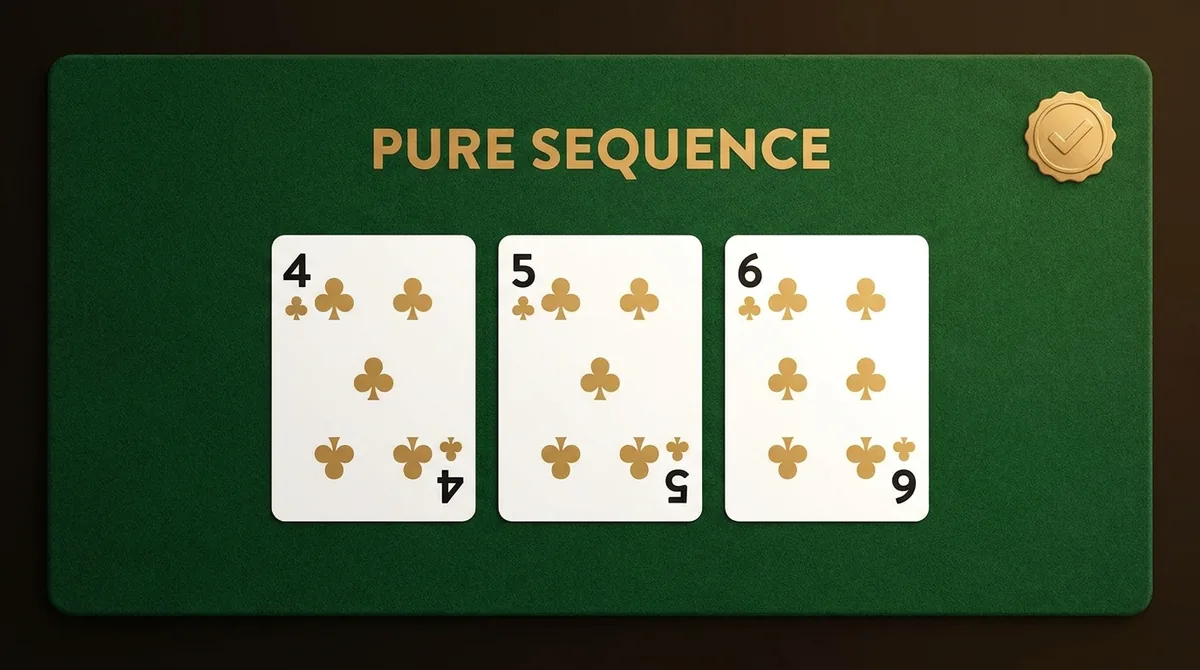
A joker makes a sequence impure by definition. It can complete your second sequence and your sets — but your one compulsory pure sequence must be all natural cards.
How Scoring Works in 13 Patti
A valid rummy declaration scores zero under the standard penalty model described here. Other players count eligible ungrouped cards according to the stated point values and any applicable cap. Check the pure-sequence requirement before excluding completed groups from that calculation, because an invalid declaration changes how the hand is assessed.
13 Patti is a points game, and in rummy low is good. The winner declares with zero points; everyone else scores the value of the cards they failed to group:
- Number cards are worth their face value (a 7 = 7 points).
- Face cards (J, Q, K) and Aces are worth 10 points each.
- Jokers are worth 0.
- A wrong declaration costs a flat penalty (commonly 80), and a first-drop or middle-drop costs 20 / 40.
Your loss in any deal is capped at 80 points, so even a terrible hand has a known worst case — another reason 13 Patti rewards calm, skillful play over wild game.
13 Patti vs 3 Patti: the Difference in One Table
13 Patti builds groups from thirteen cards; 3 Patti compares the strength of three-card hands. A rummy sequence is part of a declaration, while a Teen Patti sequence is one category in a ranking ladder. Compare hand size, objective, turn action and joker treatment before transferring a familiar term between games.
Because the names look so similar, here is the side-by-side that clears it up for good.
Came here for the three-card game after all? Jump to our 3 Patti sequence list for hand rankings, or the full how to play Teen Patti guide. Want to go deeper on 13 Patti? Start with the Indian Rummy rules and how to win at rummy.
Learn 13 Patti by playing on Teen Patti Stars
Free practice tables are the fastest way to lock in sequences and sets. Play rummy and 3 Patti in one app — 18+, APK download.
Download Master APKFAQ
These answers resolve the short questions that arise while using 13 Patti rules. Read each answer with the convention or product record identified in the article. A general game rule, a source-listed amount and an account-specific condition answer different questions, so keep their original context together.
What is 13 Patti?
Is 13 Patti the same as Teen Patti?
How many cards are in 13 Patti?
What is a pure sequence in 13 Patti?
How do you win at 13 Patti?
India Games Guide Editorial Desk
The editorial desk maintains the source adaptation, rule explanations, app particulars and descriptive links. Read the editorial method and correction policy.
Related Guides
The related guides extend the decisions introduced in 13 Patti rules: learn the underlying game rule, inspect a particular product record or check an account-safety question. Select the descriptive topic that matches your next task. App information and promotional figures stay attached to their own source records.